




Copyright 2019 Reflux Design
About Me
I am an Assistant Professor (Chargée de cours) at Université Libre de Bruxelles (ULB) at Brussels.
Photo Credits: Mirza Ahad Baig
Where I’ve been:
I was a post-doctoral researcher (2024-2026) at Institute of Science and Technology Austria (ISTA) in the group headed by Thomas A. Henzinger.
I did my PhD (2019-2023) at the University of Warwick where I was fortunate to be supervised by Marcin Jurdziński.
I got my B.Sc(Hons.) in Mathematics and Computer Science (2014-2017) and M.Sc in Computer Science (2017-2019) from Chennai Mathematical Institue (CMI).
My name
My name is Thejaswini (pronounced /ˈt̪eː.dʒa.swɪ.ni/, approx. “Tay-ja-swi-ni”). When I publish, it is under the name K. S. Thejaswini, where Thejaswini is my surname. Feel free to always address me as Thejaswini.
The initials K and S in my name expand to expand to Kodaganalloor Srinivasa Raghavan, where Kodaganalloor is my patrilineal ancestral village, and Srinivasa Raghavan is my father’s first name.
The naming system in some parts of south of India is patronymic . In contexts where a first name and last name are required, I sometimes use the form Thejaswini Raghavan.
I prefer to be addressed as Thejaswini in almost all contexts, since Raghavan is my father’s first name :).
My research
My research interests broadly lie in logic, automata theory, infinite games, reactive synthesis, and formal verification. In general, I am motivated by questions arising from verification and synthesis of reactive systems. Recently, I have also been working on verification and synthesis in privacy-preserving settings.
My PhD dissertation is about algorithms for parity and Rabin games. In particular, I have worked on algorithms for parity games and Rabin games. Algorithms for solving such games are of both theoretical interest and also form the algorithmic backbone of many problems in verification and synthesis.
Research
Below are some selected publications, accompanied by combinatorial objects from the work or screenshots from presentations. I am always happy to be contacted to discuss problems in the topics mentioned below, or any related areas.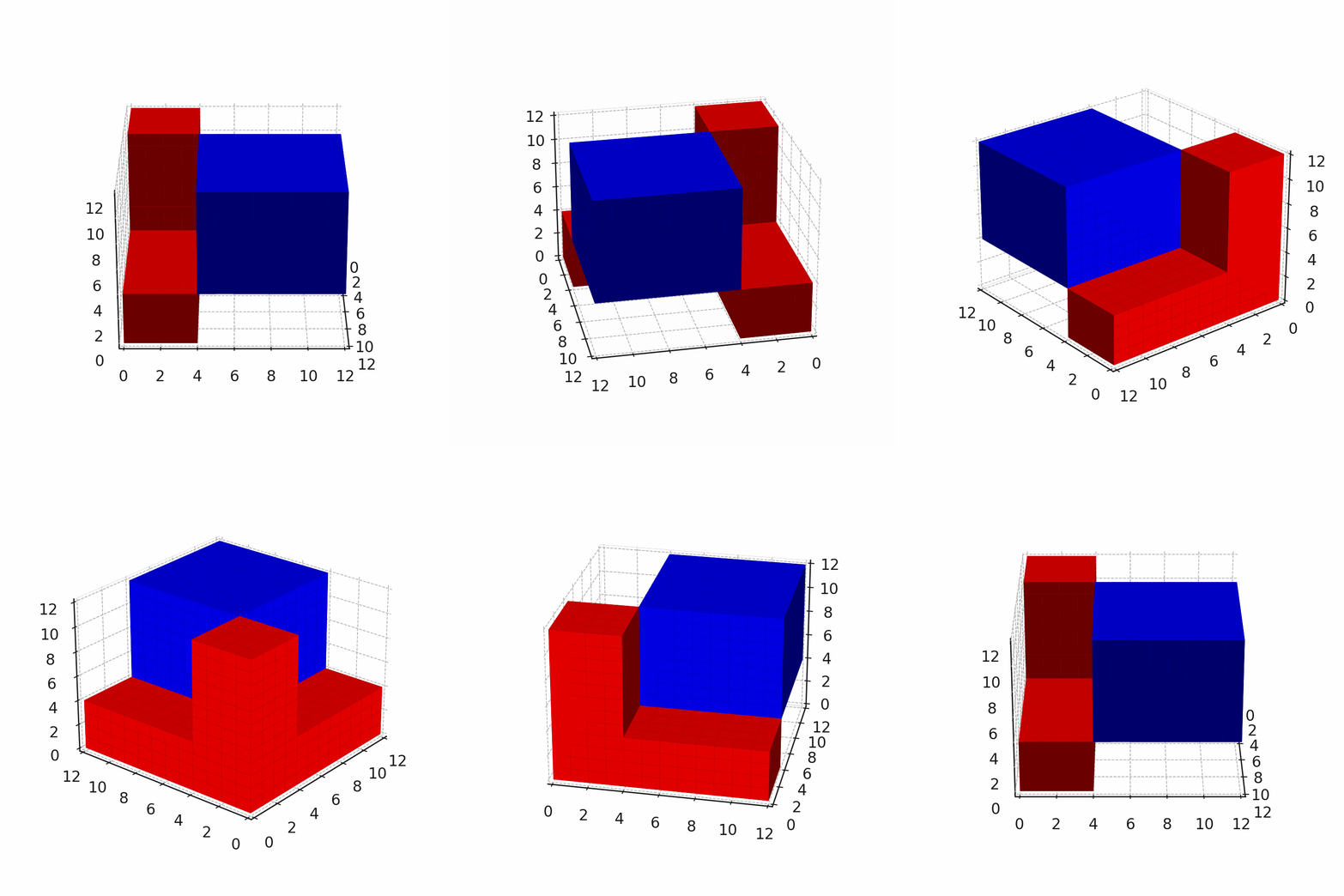
Dicey Games: Shared Sources of Randomness in Distributed Systems (LICS 2026)
We introduced Dicey Games, a framework for distributed systems in which a team shares limited sources of randomness. We characterised the existence, representation, and computational complexity of optimal strategies, and studied how to best allocate the limited sources of randomness within a team.
Dicey Games: Shared Sources of Randomness in Distributed Systems (LICS 2026).
Joint work with Léonard Brice, and Thomas A. Henzinger.

Randomise Alone, Reach as a Team (CAV 2026)
We study concurrent graph games where a team of players cooperates against an opponent to reach a target, while randomising privately without sharing their sources of randomness. We show that memoryless strategies suffice for the threshold problem, placing it in the existential theory of the reals, and introduce a logic (IRATL) and a solver for reasoning about such coalitions.
Randomise Alone, Reach as a Team (CAV 2026).
Joint work with Léonard Brice, Thomas A. Henzinger, Alipasha Montaseri, and Ali Shafiee.

Decoupled Planning for Multiple Omega-Regular Objectives (CAV 2026)
We study how to generate paths on a graph that satisfy several ω-regular objectives at once, by assigning each objective to an independent agent and letting an oblivious scheduler compose their local policies. We characterise when such decoupled composition succeeds, and when coordination or shared conventions between agents become unavoidable.
Decoupled Planning for Multiple Omega-Regular Objectives (CAV 2026).
Joint work with Guy Avni, Thomas A. Henzinger, Kaushik Mallik, and Suman Sadhukhan.
Privacy-preserving runtime verification (CCS 2025)
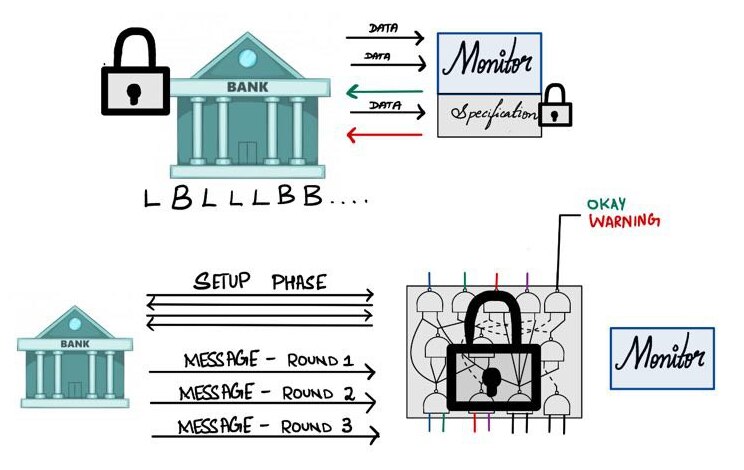
We provided protocols to verify safety properties at runtime in a privacy-preserving manner. Our protocol ensures that the system remains oblivious to the monitored specification, while the monitor learns only whether the system satisfies the specification and nothing more.
Privacy-preserving runtime verification (CCS 2025).
Joint work with Thomas A. Henzinger and Mahyar Karimi.
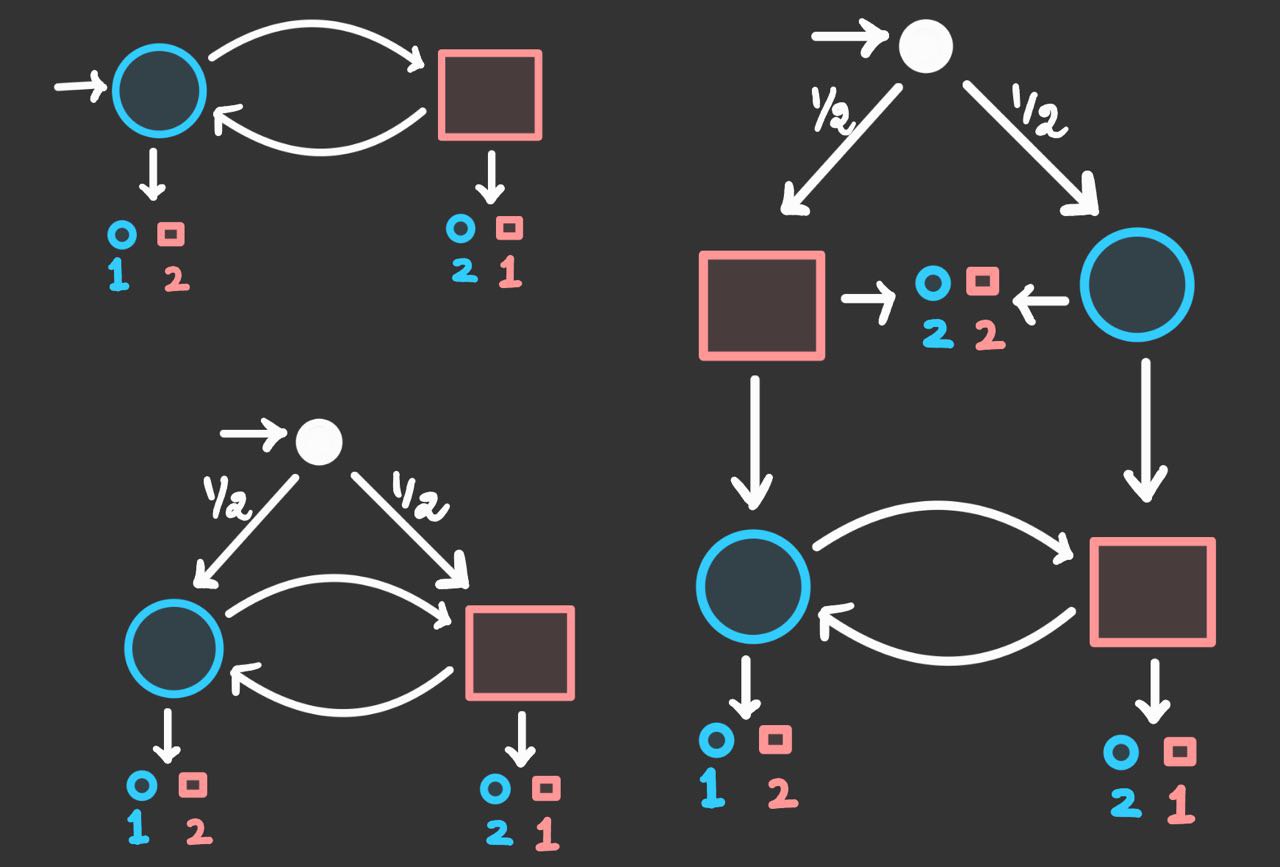
Finding Equilibria: simple with optimists and simpler with pessimists (MFCS 2025)
We introduced the notion of extreme risk measure and studied it in the settings of multi-player graph games. These risk-measures also provide computationally tractable alternative of studying non-zero sum games with multiple players
Finding Equilibria: Simple with optimists and simpler with pessimists (MFCS 2025).
Joint work with Léonard Brice, and Thomas A. Henzinger.
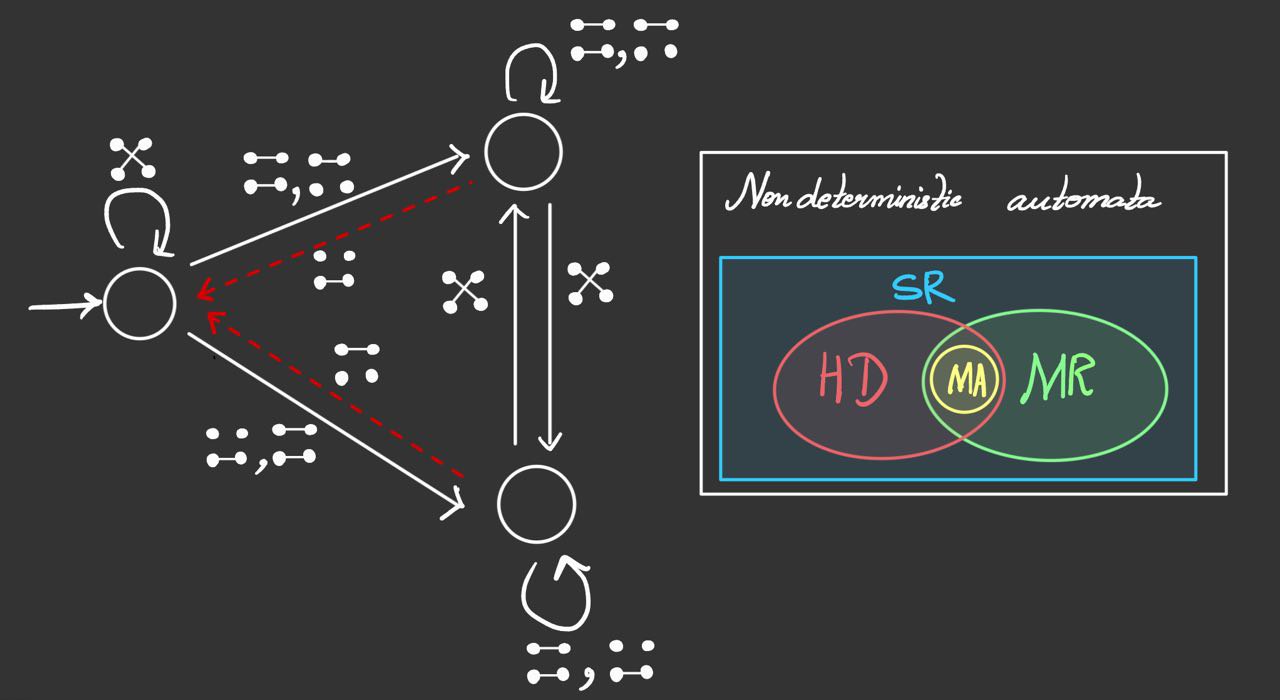
Resolving nondeterminism with randomoness (MFCS 2025)
We introduced several intermediate notions of nondeterministic parity automata where some memory and randomness can be used to almost-surely resolve the nondeterminism.
Resolving nondeterminism with randomness (MFCS 2025).
Joint work with Thomas A. Henzinger and Keya Prakash.
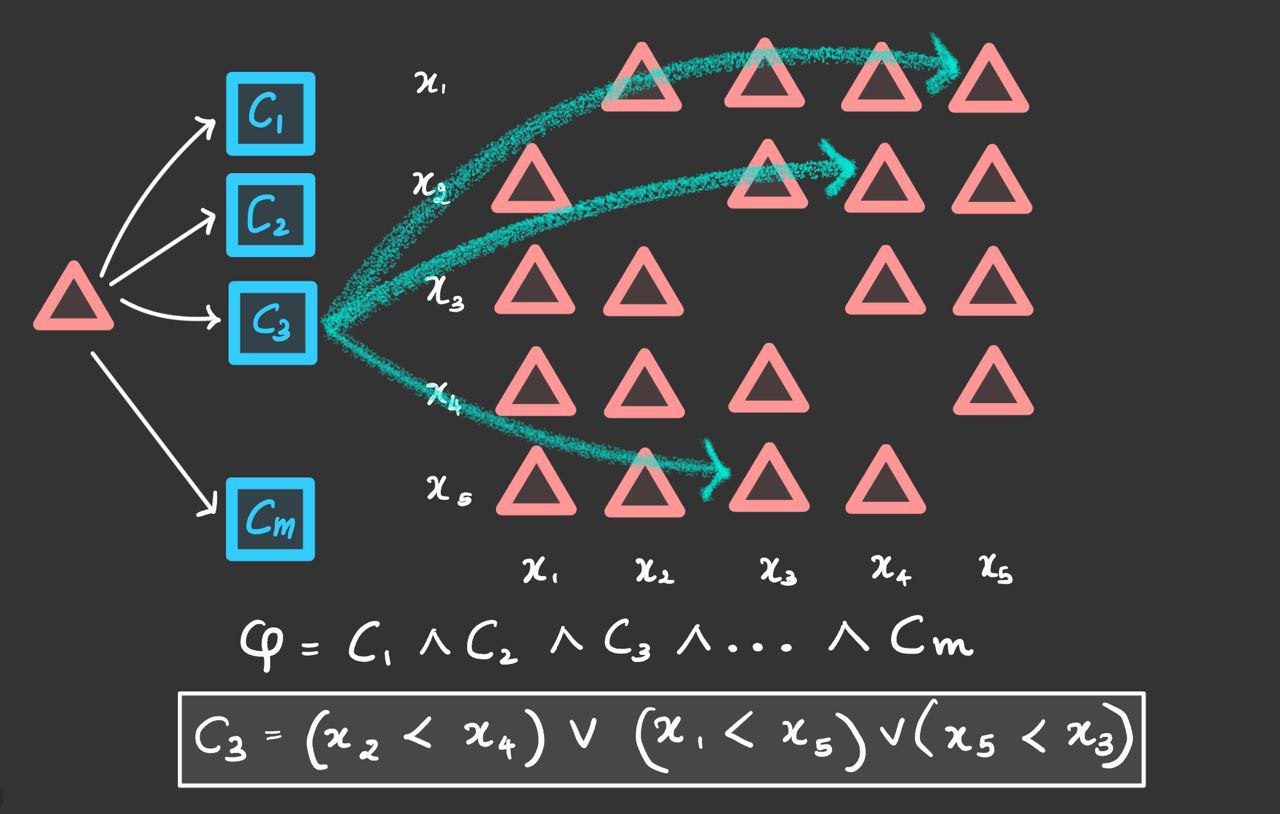
Simple and tight complexity lower bounds for solving Rabin games (SOSA 2024)
We provided an alternate complexity lower bounds subject to the exponential time hypothesis for solving Rabin games using a variation of SAT, called permutation-SAT.
Simple and tight complexity lower bounds for solving Rabin games (SOSA 2024).
Joint work with Antonio Casares, Marcin Pilipczuk, Michał Pilipczuk, and Uéverton S. Souza.
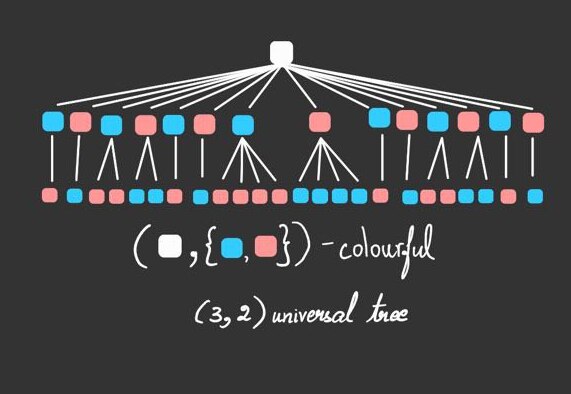
Rabin games and colourful universal trees (TACAS 2024)
We improved the running time and space complexity of Rabin games by constructing succinct combinatorial objects---colourful universal trees.
Rabin games and colourful universal trees (TACAS 2024).
Joint work with Rupak Majumdar, and Irmak Sağlam.
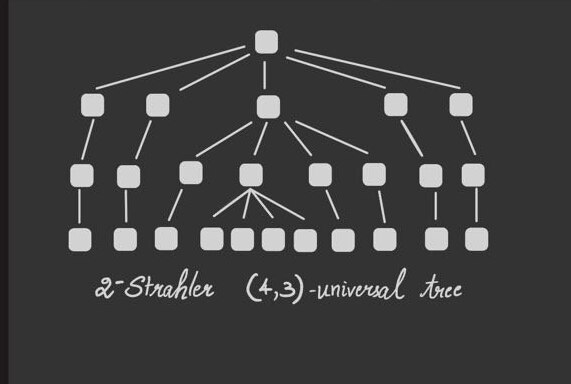
Strahler number of a Parity game (ICALP 2020)
We identified Strahler number as a fundamental parameter in a parity game, constructed succinct Strahler Universal trees that produced faster and space-efficient algorithms parameterised by Strahler number
Strahler number of a Parity game (ICALP 2020).
Joint work with Laure Daviaud, and Marcin Jurdziński.
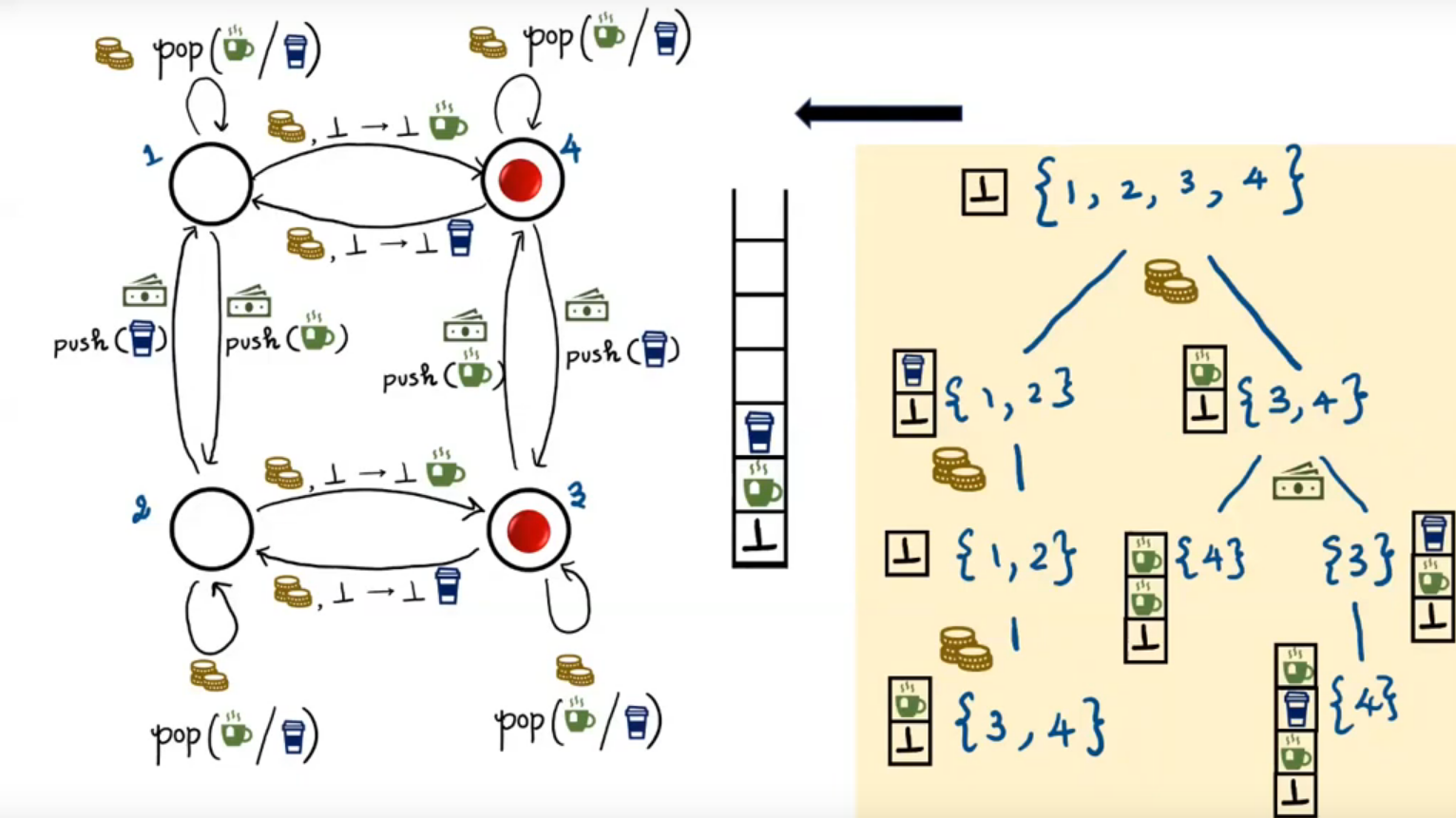
Adaptive Synchronisation of Pushdown Automata (CONCUR 2021)
We introduced and studied the notion of adaptive synchronization in pushdown automata where the stack contents are visible. We showed complexity bounds of deciding if there is an adaptive seqence that synchronises such automata.
Adaptive Synchronisation of Pushdown Automata (CONCUR 2021)
Joint work with A. R. Balasubramanian.
Teaching
Current and past teaching.Data Structures
I am developing a 12-hour course on Databases and their structure in the Fall semester of the academic year 2025-2026 at ULB.
Complexity theory
I taught a short course on Complexity theory at ISTA aimed at first and second year PhD students during the academic year 2024-2025.
Teaching Assistantship at Warwick
I have been a teaching assistant at the University of Warwick for CS409 - Algorithmic Game Theory, CS259 - Formal Languages, and CS260 - Algorithms.
Teaching Assistantship at CMI
for Games on Graphs, Data Mining and Machine Learning, Advanced Algorithms, Theory of Computation, and Introduction to programming: Haskell.
Services
Current
- Communications chair of Highlights of Logic Automata and Games.
- PC Chair of SYNT 2026
- Member of the steering committee of the Logic Mentoring Workshop (since 2023)
- Co-organiser of the Workshop on Automata and Games for Synthesis (WAGS) co-located with FSTTCS(2024, 2025)
Previous
- PC Member of CONCUR 2024
- Organising Committee member of the Logic Mentoring Workshop for two editions: 2022,2023
- where LMW@LICS, was co-located with LICS 2023, Boston, USA
- and LMW@CSL was co-located with CSL 2022 edition, Warsaw, Poland - Sub-reviewer for journals:
- Information and Computation (2024)
- Journal of Computer and System Sciences (2024)
- TheoretiCS (2023)
- Sub-reviewer for conferences:
- PODC 2026, ICALP 2026, LICS 2026, STACS 2026, ICALP 2025, STOC 2024, ICALP 2024, MFCS 2023, CONCUR 2023, FSTTCS 2022, MFCS 2022, LICS 2022, FoSSaCS 2022, CSL 2022, FSTTCS 2021, LATA 2020, ICALP 2020, LICS 2020